At Imperial College London, researchers are using Lenovo-powered high-performance computing cluster HX1 to combine advanced simulation and AI to help turn fusion from a scientific breakthrough into a practical source of energy.
Every time someone boils a kettle, charges their phone or switches on a light, they rely on energy systems built over decades of scientific and engineering progress. Researchers at Imperial College London are working on what could become the next leap forward: fusion energy.
Fusion powers the Sun and other stars, and fusion reactions can produce energy. The challenge now is turning that into a reliable, scalable source of electricity that can power homes, businesses and entire energy grids.
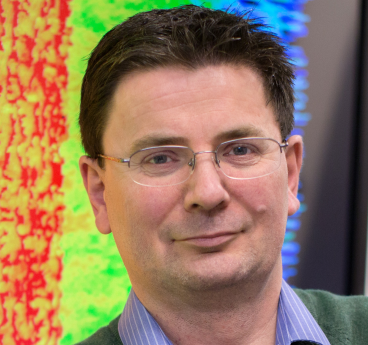
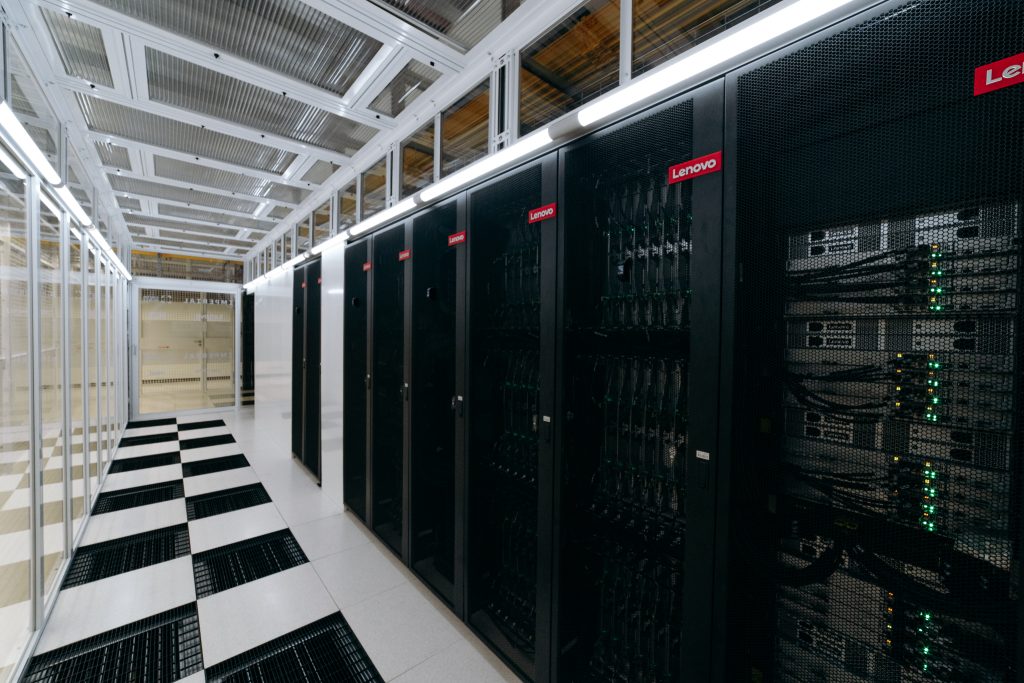
To help solve this challenge, researchers Professor Jeremy Chittenden and Dr Aidan Crilly are using HX1, Imperial’s Lenovo-powered high-performance computing cluster, to test fusion concepts digitally.
For decades, fusion has been described as the energy source of the future. Today, researchers remain cautious, but momentum is building. As Chittenden, Professor of Plasma Physics and head of Imperial’s Centre for Inertial Fusion Studies, puts it: “Someone has hit the accelerator pedal.”
At Imperial, HX1 is helping researchers keep pace with that acceleration. HX1 supports 120 researchers per month (over 200 across the year) who collectively use more than three million node hours each year. HX2 will replace the current High-Throughput Cluster which supports nearly 1500 researchers per month (3000 across the year) who collectively use more than 22 million node hours each year.
Built on Lenovo high-performance computing infrastructure, HX1 enables researchers to combine large-scale plasma simulations with machine learning-driven design workflows that would otherwise be impractical.
The result is more than faster computing. Researchers can eliminate weaker designs earlier and focus resources on the most promising ideas before a laboratory experiment ever begins.
Recreating star-like conditions on Earth
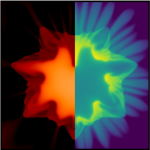
In inertial fusion – the area Chittenden and Crilly work on – researchers try to recreate optimal fusion conditions in the laboratory by rapidly compressing and heating a tiny fuel target.
“These experiments are dumping a lot of energy into material,” explains Crilly, a Research Fellow in the Centre for Inertial Fusion Studies and Imperial’s AI initiative, I-X. The target can be smaller than a peppercorn. Powerful lasers or other high-energy drivers compress and heat it and, for a brief moment, it becomes plasma – a state of matter that mirrors conditions found inside stars. “It gets really, really hot – hotter than the core of the Sun,” continues Crilly.
The scientific ambition is huge, but there is a clear practical challenge. Producing fusion energy once is not enough; researchers must develop systems capable of generating it repeatedly and efficiently at power-generating scale. A future fusion power plant may need to operate multiple times every second while producing far more energy than today’s experimental systems.
The experiment before the experiment
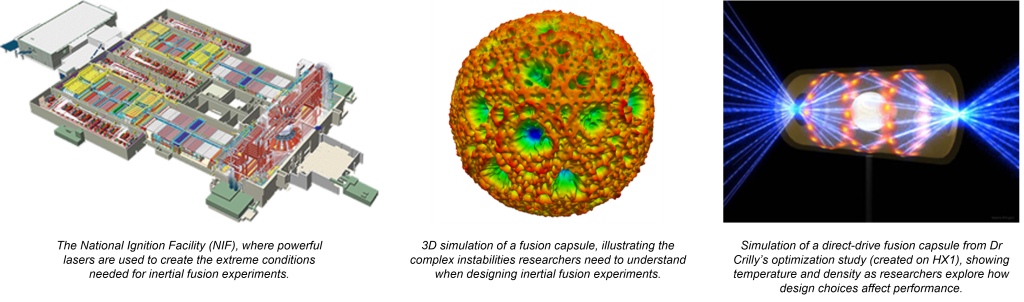
Fusion experiments depend on specialised facilities, powerful lasers and extraordinary precision. Testing every possible design in the laboratory would be prohibitively expensive and time-consuming.
Crilly describes it as a design problem with too many variables for traditional trial and error. “Everything is about compressing energy down,” he says. “Everything needs to meet at the same point at the same time. There’s a lot of precision required.”
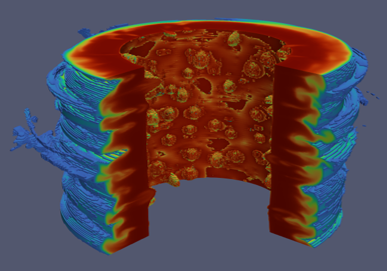
Chittenden’s and his peers have spent more than 20 years developing modelling tools used to support fusion research programmes around the world. “The thing that makes it unique is not the individual bits of physics,” he says. “It’s the collective behaviour of all of them acting simultaneously.”
Local access to HX1 is critical because it allows researchers to develop models, run large-scale campaigns and refine designs without waiting for access to external facilities.
From one simulation to intelligent exploration
“The ability to run hundreds or even thousands of examples of simulation output is key for machine learning-driven optimisation design,” says Chittenden. “Without a platform like HX1, we really couldn’t operate at the scale we have.”
Researchers can explore hundreds or thousands of possibilities simultaneously, using machine learning to identify which options are most promising. This fundamentally changes how research is conducted.
Crilly describes one recent workflow as a multi-fidelity design process. The team uses fast, lower-cost simulations to explore broad trends before validating the strongest candidates with more detailed models.
The faster simulations can miss important physics, while the most detailed simulations can be around 200 times more computationally expensive. Machine learning helps bridge the gap, reducing the number of expensive calculations required while guiding researchers toward better designs.
AI as an accelerator, not a replacement
Is the growing role of machine learning changing the scientist’s job? Researchers still need to understand the physics behind the results, recognise when a simulation has behaved unexpectedly and decide when a model needs improvement.
Crilly says the scientist’s role may move “a step up” in abstraction: setting the larger goal, defining what success looks like, improving the physics model and judging whether the result can be trusted. “Our job is making sure the simulation is as complete with the physics as it can be,” he says. “That’s still the domain of the scientists.”
That distinction matters because HX1 is not just about running simulations faster, but about helping scientists explore a wider range of possibilities and focus their time where it matters most.
Infrastructure for the next phase of discovery
Fusion modelling requires traditional high-performance computing for large-scale physics simulations, but is also increasingly reliant on machine learning and AI workflows, requiring both CPUs and GPUs.
Each increase in computing capability allows researchers to run larger simulation campaigns, test more ideas, build more sophisticated models and combine physics-based simulation with machine learning.
Projects such as HX1 demonstrate how advanced computing infrastructure can accelerate scientific discovery, allowing better-informed decisions before committing resources to physical experiments.
Crilly is clear that, in this field, there is no such thing as too much compute.
“If a bigger computer appeared, you either run more jobs or you run a bigger one. You’re never going to be handed a computer cluster and say, ‘It’s too big.’”
Computing at the pace of discovery
Fusion remains a major scientific and engineering challenge. Chittenden says concepts that once seemed decades away are now moving toward testing in just a few years. That brings excitement, but also pressure.
“We have to make accurate predictions for what to expect,” he says. “They have to be right, and we haven’t got a lot of time to do it in.”
For Lenovo and Imperial, HX1 represents a new pace of science – one where high-performance computing, AI and simulation work together to help researchers tackle problems that were previously beyond reach.
As fusion research moves from theory toward deployment, the ability to evaluate millions of possibilities before a single experiment takes place may help determine how quickly it becomes reality.
As next-generation models of HX1 are developed – such as HX2 and HX3 – the approach could also accelerate discovery far beyond energy, from advanced manufacturing and materials science to a plethora of technologies yet to be imagined.
HX1 is not only helping researchers explore the future of energy. It is helping demonstrate how the future of scientific discovery itself may be built.
Read more about Imperial’s partnership with Lenovo and Intel here.
Read more about the launch of Imperial’s new supercomputing facility here.